Best Marine Batteries for Yachts (2026): Lithium vs. AGM Buying Guide

A boat's house battery bank is the system most owners think about least — until it dies. A weekend trip cut short by dead batteries is no fun; a longer cruise that ends with a tow because the start battery couldn't crank is worse. Worth getting this right.
This guide covers the four battery chemistries you'll actually choose between, our top picks in each category, and what to skip. All prices are approximate as of mid-2026.
The two questions that determine your battery
Before shopping, answer these:
1. Starting or house?
- Starting (cranking) batteries deliver a huge burst of current for a few seconds to start the engine, then recover. They don't tolerate being deeply discharged.
- House (deep cycle) batteries deliver lower current for hours, recovering from being drained 50–80%. They don't crank engines well.
- Dual-purpose batteries split the difference — OK at both, master of neither. Fine for small boats; suboptimal for yachts that ask serious work of both systems.
Yachts typically have at least one starting battery per engine plus a separate house bank.
2. Lithium or lead-acid?
- Lithium (LiFePO4): 3-4x lifespan, 70% lighter, recharges 5x faster, dischargeable to 80%+ without damage. Costs 3-4x upfront.
- AGM (Absorbed Glass Mat): today's standard for lead-acid. Sealed, vibration-resistant, OK at 50% discharge. Half the price of lithium.
- Gel: older, more delicate. Mostly displaced by AGM.
- Flooded (traditional): cheapest, requires periodic water top-ups, doesn't tolerate vibration well. Mostly skipped on modern yachts.
For most cruisers, lithium is worth the upgrade for house bank — the weight savings and faster recharge from solar/alternators are real. AGM stays competitive for starting because cranking discharge is brief and shallow.
1. Battle Born 100Ah LiFePO4 (Best Lithium for Most Yachts)

For: house bank on most cruising yachts. The benchmark name in marine lithium. 31 lbs vs. 65 lbs for an equivalent AGM. 3,000+ cycles at 80% depth of discharge. Built-in BMS handles charge protection. Made in the U.S. with a 10-year warranty — the longest in the industry. Pricey ($800–$950) but the value math works at 8–10 years of use vs. replacing AGMs every 4-5 years.
2. Renogy 100Ah LiFePO4 with Bluetooth (Best Value Lithium)
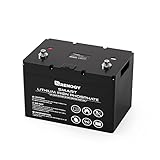
For: owners who want lithium without paying full Battle Born premium. 4,000+ cycles, self-heating function for cold-climate boats, Bluetooth monitoring via the Renogy app, IP67 dust/waterproof. Around $400–$550 — roughly half the cost of Battle Born for similar specs. Renogy's 5-year warranty isn't quite Battle Born's, but for most owners the savings make sense.
3. Optima D34M BlueTop (Best Dual-Purpose AGM)
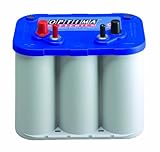
For: small to mid-size boats needing one battery for both starting and modest house duty. The classic dual-purpose AGM. SpiralCell construction is famously vibration-resistant — important on planing hulls or rough-water cruisers. 750 CCA for cranking, 55 Ah deep-cycle capacity. Around $300–$400. If you only have room or budget for one battery on a boat under 30 feet, this is the safe pick.
4. VMAX MR127 (Best Budget AGM for Trolling Motors / House)

For: budget-conscious house banks, trolling motor power, secondary banks. A solid Group 27 AGM with 100Ah capacity. Less premium than Optima or Battle Born but at a meaningful price point ($230–$280). VMAX is a Brooklyn-based company that's been making AGM batteries for two decades — proven, no surprises. Good choice when you need capacity but the budget doesn't stretch to lithium.
How to size your house bank
Add up the amp-hours you'll consume in a typical 24-hour period (running fridge, lights, electronics, pumps). Multiply by 2 (so you only run the bank to 50% in the case of AGM) or 1.25 (for lithium). That's your minimum bank size.
Quick reality check:
- Weekender (no overnight away from shore power): 100Ah AGM is fine.
- Weekend cruiser (1–2 nights at anchor): 200Ah AGM minimum, or 100-200Ah lithium.
- Liveaboard / serious cruiser: 400Ah+ lithium. AGM at this scale gets prohibitively heavy.
What to skip
- Cheap lead-acid "marine" batteries from auto parts stores. Often just relabeled automotive batteries. Won't survive deep discharge on a boat.
- Mixing battery chemistries in the same bank. Lithium and AGM charge at different voltages — you'll undercharge one and overcharge the other.
- Lithium batteries without an LFP-compatible charger. Standard marine chargers can damage lithium cells. Make sure your charger and alternator output match.
- Trickle-charging lithium to "top off." Lithium cells don't need (and don't tolerate) the same float-charging treatment as lead-acid.
Charging upgrade — usually needed when going lithium
Lithium batteries need a charger that supports LFP charging profiles. Most boats over 5 years old have AGM-only chargers. Budget another $300–$600 for an upgrade. This is one of the costs people forget when budgeting a "switch to lithium" project.
For an electrician to handle the charger swap and ensure your alternator output is compatible, browse our marine electrical directory.

Bottom line
For most yacht owners doing a battery upgrade in 2026:
- All-out best: Battle Born 100Ah lithium for the house bank, Optima D34M BlueTop for starting.
- Best value: Renogy 100Ah lithium for the house bank, Optima D34M for starting.
- Budget AGM: VMAX MR127 (×2-3 for capacity) for the house bank, Optima D34M for starting.
Whatever you pick, replace all batteries in a bank at the same time — never mix old and new. The new batteries will be pulled down to the level of the old ones in days.
Photos by Unsplash contributors. Product images via Amazon.