Best Handheld Marine VHF Radios (2026): Top Picks for Yacht Owners

Cellphone signal disappears about 5 miles offshore. The Coast Guard, marina staff, fellow boaters, and weather updates all live on VHF. A handheld is the cheapest insurance you can carry — and the one piece of gear that's saved more lives than any other electronic on board.
This is our take on the best handheld marine VHF radios for 2026, what to look for, and what to skip.
What actually matters in a handheld VHF
The features that matter (in order):
- Floats and is waterproof. IPX7 minimum, IPX8 better. If it sinks the moment you drop it overboard, it's the wrong radio.
- 6 watts transmit power. Older or budget radios are 1W or 3W. 6W roughly doubles your range — meaningful when you need to reach the Coast Guard 15+ miles away.
- NOAA weather alerts. All marine VHFs receive weather, but radios with "alert" mode wake up and beep when severe weather is broadcast. Hugely useful at anchor.
- DSC (Digital Selective Calling). Push-button distress signaling that broadcasts your GPS coordinates automatically. Required for new fixed-mount VHFs; optional but valuable for handhelds.
- Battery life. Aim for 8+ hours under normal use. Some radios have removable AA-battery trays as backup — gold for offshore.
- Built-in GPS. Used for DSC distress signaling. Not strictly necessary if your boat has a separate GPS, but eliminates the dependency.
Less important: number of channels (they're all the same in marine VHF), color displays, fancy UI.
1. Standard Horizon HX300 (Best All-Around Pick)

For: the radio most yacht owners should buy. The HX300 hits the sweet spot — 5W output, IPX8 fully submersible, floats, NOAA weather alerts, USB-C rechargeable. Great battery life (around 11 hours with the included Li-ion). Standard Horizon's user interface is among the cleanest in the industry; large buttons that work with wet gloves on. About $130 — solid value for the feature set.
2. Icom IC-M37 (Best Premium Build)

For: owners who want the most rugged option. Icom is the Toyota of marine radios — boring, reliable, lasts a decade. The IC-M37 is 6W, IPX7, floats, and has Float'n Flash (the radio strobes when it hits the water, making it findable). The build quality is genuinely better than the cheaper picks; if you operate in heavy weather or commercial-grade conditions, it's worth the upgrade. About $190.
3. Cobra MR HH350 FLT (Best Budget Floating Radio)
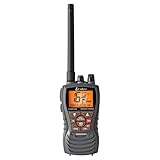
For: budget-conscious owners who still want a floating, 6W radio. Floats, 6W output, IPX7, NOAA weather, noise-canceling mic. Slightly less polished interface than the Standard Horizon but covers all the safety bases at around $90. A solid first VHF, or a great backup to a fixed-mount radio. The "FLT" model floats; older HH350 (no FLT) does not — make sure you get the floating one.
4. Uniden Atlantis 155 (Best Floating Budget VHF)
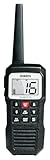
For: the absolute lowest-cost waterproof + floating option. At around $80, the Atlantis 155 is hard to beat for the price. 1W/3W (lower than the others — meaningful for long-range comms), but it floats, is IPX8 submersible, and has weather alert. Battery life is 10+ hours. A great primary for inshore boats or backup for anyone with bigger gear. If you can't afford the others, this is more than acceptable.
5. Uniden MHS75 (Best Compact Backup VHF)

For: backup radio that lives in a ditch bag or tackle box. Smaller than the others, 5W with selectable 1/2.5/5W output. IPX8 submersible (but doesn't float — keep it on a lanyard). $90. Good radio for what it is, but the lack of float makes it second-choice as primary. Where it shines: in a ditch bag, where you want something compact and fully waterproof at 5W.

How to actually use a VHF (skip if you know)
Most VHF mistakes come from inexperience. The basics:
- Channel 16 is the international hailing/distress frequency. Always monitored. Don't carry on conversations there — call, then switch to a working channel.
- Channel 9 is the alternative hailing channel in the U.S.
- Channels 68, 69, 71, 72, 78A are common working channels for ship-to-ship in the U.S.
- Channel 22A is the Coast Guard's working channel after they direct you off 16.
- Channels WX1–WX9 are NOAA Weather Radio (continuous broadcast).
To make a normal call: "Vessel name, vessel name, this is calling vessel, calling vessel, on channel 16. Over." Wait 30 seconds. If they respond, agree on a working channel and switch.
To make an emergency call: hold the DSC distress button on a DSC-equipped radio for 5 seconds. It broadcasts your GPS position automatically. Then transmit verbally on 16: "Mayday, mayday, mayday. This is [vessel name]. [vessel name]. [vessel name]. Position [coordinates]. Number of people on board. Nature of emergency. Over."
Practice this once on a quiet day, with the squelch up so you don't actually transmit. Your future self will be grateful you don't have to look it up under stress.
What to skip
- Non-floating handhelds (unless purely as backup). A non-floating radio that drops overboard is gone.
- Anything under 1W transmit power. Range of about 1 mile. Useless for safety.
- Multi-band scanners marketed as "marine." Marine VHF is regulated; consumer scanners can listen but can't legally transmit on marine frequencies.
- Older non-DSC radios for new purchases. DSC is now standard and the price difference is minimal.
Bottom line
For most yacht owners in 2026:
- All-out best: Standard Horizon HX300
- Most rugged: Icom IC-M37
- Best budget floating: Cobra MR HH350 FLT or Uniden Atlantis 155
- Backup / ditch-bag: Uniden MHS75
Whichever you pick, carry it always when underway, charge it before every trip, and check the test broadcast on channel 16 weekly so you know it works before you need it.
For more on calling for help in marine emergencies, see our marine weather safety guide.
Photos by Unsplash contributors. Product images via Amazon.