Best Boat Fenders and Dock Lines (2026): A Practical Buying Guide

Fenders and dock lines are the gear nobody thinks about until they fail. Then they're the difference between a scratched hull and a $5,000 gelcoat repair. Both wear out faster than owners realize — UV degrades vinyl in 4-7 years, and dock lines lose 30% of their strength after 5 seasons in the sun.
This is our 2026 buying guide for the gear that actually performs.
How to size fenders
The standard rule: 1 inch of fender diameter per 4 feet of boat length, minimum. So:
- 24-foot boat: 6-inch fenders
- 32-foot boat: 8-inch fenders
- 40-foot boat: 10-inch fenders
- 50-foot boat: 12-inch fenders
How many to carry: one fender per 10 feet of boat length, plus one spare. A 32-foot boat needs 3-4 fenders aboard at all times.
Length matters too: longer fenders give more vertical coverage if your boat rocks at the dock. Cylindrical fenders (Polyform G-series) are the standard; ball/buoy fenders (Polyform A-series, Taylor Made Tuff End) are useful for floating-dock scenarios where the boat can ride up a piling.
How to size dock lines
A common mistake: dock lines that are too short. Practical sizing:
- Length: at least 1.5x your boat length per line. For a 32-foot boat, that's 48 feet minimum. Carry at least one line that's 2x boat length (64 ft) for "looser" tie-ups in tidal zones.
- Diameter: for boats up to 25 ft, 3/8" line. 25-35 ft, 1/2" line. 35-45 ft, 5/8" line. 45-60 ft, 3/4" line. Bigger boats need rope rated for higher loads.
- Material: double-braid nylon is the gold standard. Stretches just enough to absorb shock without slack-and-slam, lasts 5-7 years.
- Quantity: minimum 4 lines — bow, stern, and 2 spring lines. Carry 6-8 for serious cruising.
1. Polyform G-4 (Best Mid-Size Fender)
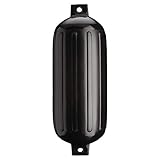
For: boats from 20-35 feet. The Polyform G-series is the industry standard. The G-4 is 6.5" x 22" — sized correctly for most center consoles and small cruisers. Heavier vinyl than the no-name brands, ribbed surface that grips dock pilings without sliding. Available in white, black, navy, sand, and several other colors. Around $25-35 each.
2. Polyform G-4 4-Pack (Best Value for Outfitting)

For: new boat owners outfitting from scratch, or replacing all fenders at once. Same G-4 fender as above, but in a 4-pack at meaningful per-fender savings. About $90-110 for 4 fenders. The right way to buy if you need to outfit a new boat or replace a sun-damaged set. Comes with line eyelets but no lines.
3. Taylor Made Big B 10" x 26" (Best Larger Fender)
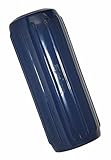
For: boats 30-45 feet. Taylor Made's main competition to Polyform. The Big B is sized for larger yachts, with a center rope tube (you can run a line through the fender vertically rather than tying to an end eyelet). Heavier-duty vinyl than the cheaper offerings. Around $50-65 each. The black version hides dock scuffs better than white.

4. New England Ropes Double Braid Dock Line (Premium Lines)

For: owners who want the best dock lines money can buy. New England Ropes makes the lines that show up in serious yards and racing programs. The 3/8" double-braid nylon stretches just enough to absorb shock but doesn't permanently deform under load. Pre-spliced eye on one end, ready to use. Lasts 7-10 years even with heavy use. Around $25-35 per 25-foot line. The pre-spliced eye saves 15 minutes per line over splicing yourself.
5. Seachoice Double-Braid Dock Line (Best Budget Lines)
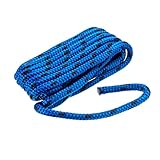
For: budget outfitting or backup lines. Seachoice is the value brand of marine consumables. The double-braid polypropylene-blend lines aren't quite as durable as full nylon, but at $10-15 per 15-foot line they're a third of the cost of New England Ropes. Good as backups, secondary lines for short-term use, or for owners on a tight budget. Lifespan 3-5 years vs. 7-10 for premium lines.
What to skip
- Generic foam-filled fenders. They flatten under load, then stay flat. Inflatable vinyl is the right call.
- Polypropylene rope as primary dock lines. It floats and doesn't stretch — both are bad for dock lines. (Polypropylene is for water-ski lines and throw bags, not for tying boats up.)
- 3-strand twisted nylon for new purchases. It works, but double-braid lasts longer, looks cleaner, and doesn't hockle (kink) the same way.
- Bumper-style soft fenders for permanent slip use. They're for mid-trip use against floating docks; the round versions are better at slips.
- Fender holders that don't have UV-resistant straps. The straps will fail in 1-2 seasons.
Maintenance — get this right and your gear lasts
Fenders:
- Wash monthly. Salt and dirt accumulate and make them slippery.
- Inflate properly — they should be firm, not rock-hard. Over-inflation causes splits.
- Store out of direct sun in the off-season. UV is the #1 enemy.
- Cover with fender socks if you're at a slip year-round. Adds 2-3 years of life.
Dock lines:
- Rinse fresh water every few weeks if used in salt water.
- Inspect quarterly for chafe, fading, and any soft spots.
- Re-end lines as needed: cut off chafed sections and re-splice.
- Replace if you see a 30%+ reduction in diameter at any point — the fibers are failing internally.
- Rotate lines around the boat seasonally so the same lines aren't always taking the load.
How much should this cost?
To outfit a 32-foot boat with quality gear:
- 4× Polyform G-4 fenders: $100-140
- 2× fender covers: $20-30
- 4× 25-foot New England Ropes dock lines: $100-140
- 2× 50-foot dock lines for storms: $80-110
- Total: $300-420
For a budget setup, swap to Seachoice lines and save about $100. For a premium setup, go to G-5 or G-6 fenders and a couple of 75-foot storm lines, and you're at $500-700.
For shops that can replace bow rollers, cleats, or other dock-related hardware, browse our marine repair directory.
Photos by Unsplash contributors. Product images via Amazon.